When we are young, we fall in love. We dance. We set out for distant places, carrying the sense with us that there will be another road, another season, another life waiting somewhere beyond the horizon.
Each of us moves through life gathering memories, one season after another, until those seasons become the quiet landscape of who we are.
And yet, equal to us all, no matter who we are, there comes a day when our journey in this world must come to an end.
Living in Kyoto, I sometimes find myself overcome by a strange and almost timeless feeling.
The traditions of this city have lived through more years than my own life, and through more years than my father’s life. They continue quietly, almost imperceptibly. Time itself has passed around them without disturbing them.
Walking beneath the eaves of an old machiya, or entering the grounds of a temple or shrine, I can feel the presence of centuries. Hundreds of years seem to linger in the worn wood, the stones beneath my feet, the moss growing in the shade.
And standing within that vast river of time, I cannot help but wonder how brief a human life really is.
Today is the night of the Gozan Okuribi.
Once each year, it is said, the spirits of our ancestors return to this world. And once their brief visit has come to an end, they begin their journey back to the world beyond.
On this night, fires are lit upon the mountains of Kyoto, carrying with them a prayer—that the spirits of those who have returned to us may find their way safely home.
This year, for the first time, I watched the Okuribi.
As I gazed at the great character of Daimonji burning against the night sky, I happened to notice a young girl standing beside me. She looked to be about middle-school age.
She quietly brought her hands together and bowed her head.
There was something about her small, still figure that remained in my heart.
For hundreds of years, across generations whose names have long been forgotten, people in this land have continued to remember those who came before them.
The world has changed. Cities have changed. Our lives have changed. And yet, there are some things that time cannot change.
Perhaps the human longing to remember the dead—to keep them close, even after they have disappeared from this world—is one of them.
Here in Kyoto, the boundary between the living and the dead does not seem quite so distant. The connection between those who remain and those who have gone before is still quietly honored, still woven into the rhythm of the seasons.
Watching the flames of the Okuribi, I found myself quietly moved by something that has endured across centuries:
the simple, enduring human act of remembering those we have loved.
A way of keeping the dead close.
A way of saying, even across the boundary of time, you are not forgotten.
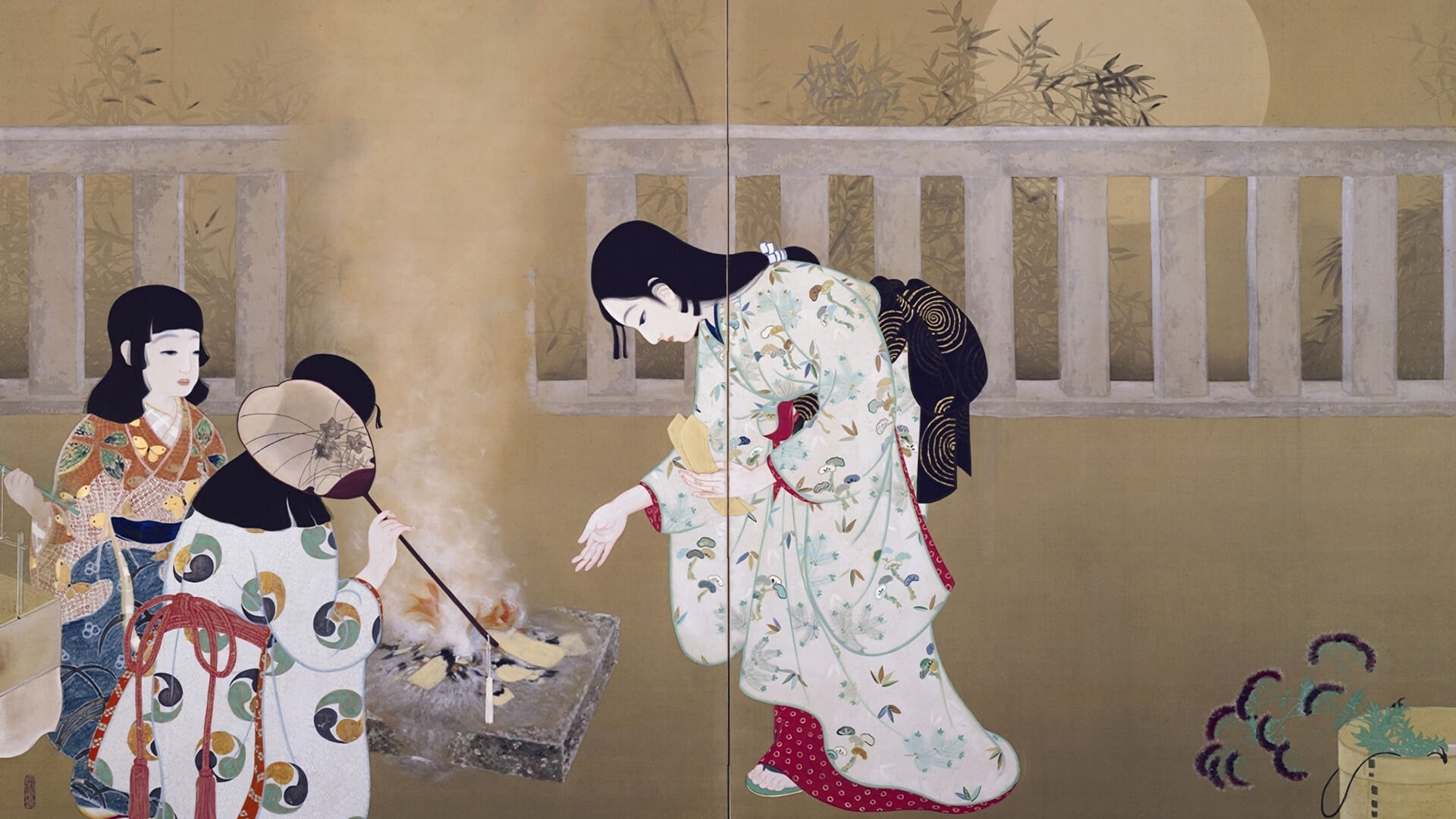
** Art by Matsumoto Ichiyo, 1920